SonarQube_General.svg

SECURE AI CODE

Advanced Security

Protect your organization from risk by using advanced SAST and SCA to review AI code, first-party code, and open-source dependencies.

TRUSTED BY OVER 7M DEVELOPERS WORLDWIDE

Mercedes Benz
Nvidia
Santander

SonarQube core security

code

SAST

Detect code vulnerabilities, early in development

code merge

Taint analysis

Cross-file data flow analysis to prevent injection attacks

cloud

IaC scanning

Secure cloud infrastructure configurations

magnifying glass

Secrets detection

Prevent exposure of credentials, tokens, and keys

Advanced Security

Requires SonarQube Enterprise (Cloud or Server)

Request free trial
integration

SCA

Comprehensive open source risk & compliance management

  • Vulnerability detection
  • Malicious package detection
  • License management
  • SBOM (Software Bill of Materials)
Explore SCA
secure

Advanced SAST

Extends taint analysis to dependencies to uncover complex vulnerabilities:

  • Dependency-aware data flow analysis
  • Uncovers vulnerabilities others miss
  • Fast and accurate 
Discover Advanced SAST
warningSCA

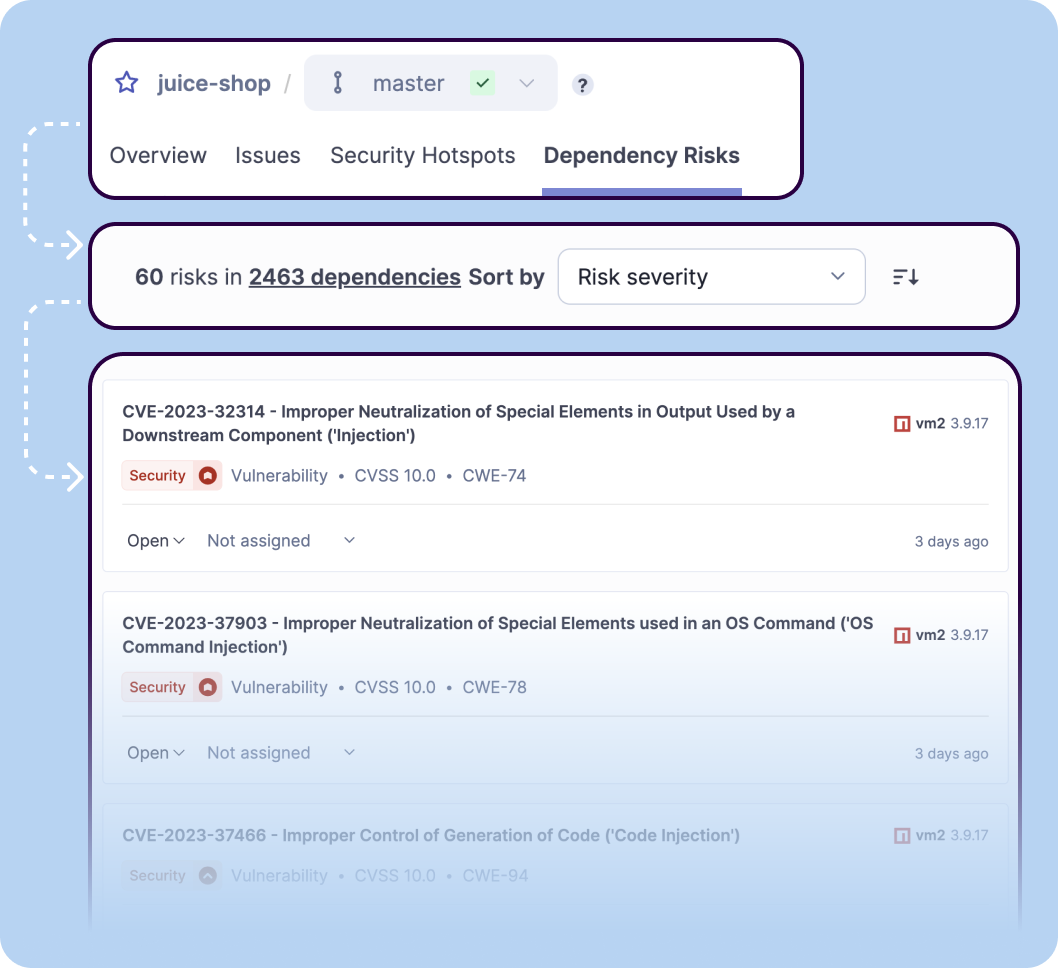
CVE detection

Fix known vulnerabilities (CVEs)

  • Detect known vulnerabilities in open source code (such as CVE)
  • Prioritize issues by severity (CVSS) and exploitability (EPSS, KEV)
  • Get additional vulnerability insights directly from the maintainer
  • Understand which versions of the dependency are safe to use
Customer story

Global luxury car manufacturer

How a global luxury car manufacturer manages code risks with SonarQube Advanced Security

Key results

  • Faster signal and reduced overhead across 550+ projects
  • Predictable software delivery
  • Accelerated response to weaponized vulnerabilities

Ecosystem support

  • Java
  • Scala Logo
  • Javascript Logo
  • Typescript Logo
  • C Sharp Logo
  • Python Logo
  • Go Logo
  • Ruby Logo
  • PHP Logo

SonarQube security reports

Comprehensive reporting for all security issues in all code

Actionable insights

Detailed code security findings with severity, trends, and remediation guidance

Rich dashboards

Visualize quality and security trends, and KPIs in unified dashboards

Compliance reports

Generate security reports for OWASP Top 10, CWE, PCI DSS, STIG, and more

Scheduled reports

Automate report delivery on daily, weekly, or monthly schedules

Integrated code quality and code security

SonarQube is an integrated code quality and security analysis platform that provides actionable intelligence to help build better software, faster.

arrows pointing up on a diagonal

Elevate code quality standards

Deliver robust, reliable, and maintainable code with fast, accurate analysis across all code

secure

Core security: foundation for secure code

Includes SAST, taint analysis, secrets detection, IaC scanning for first-party and AI-generated code

lock

Advanced Security

Advanced Security extends to open source code with advanced SAST and Software Composition Analysis (SCA)

Additional resources

Ready to secure your code?

Advanced Security FAQs

What is SonarQube Advanced Security and how does it help ensure quality code?

SonarQube Advanced Security is an enterprise-grade extension of SonarQube's integrated  platform that adds powerful software composition analysis (SCA) and advanced SAST capabilities to SonarQube’s core quality and security analysis engine. It extends SonarQube’s verification to the software supply chain by identifying risks introduced with third-party and open source dependencies.

By using SCA, the platform provides actionable, prioritized insights into dependency vulnerabilities, malicious packages, and license compliance—all while providing full visibility via software bills of materials (SBOMs). Additionally, advanced SAST extends deep taint analysis beyond first-party code and into third-party libraries. This unique capability traces data flows across code boundaries to uncover hidden, complex vulnerabilities that arise specifically from interactions with external libraries.

By integrating SCA and advanced SAST into the existing workflow, Sonar provides a single source of truth for both code quality and security , eliminating the visibility gap caused by siloed tools. It ensures that third-party components meet the same rigorous standards as your first-party code. 

What types of security vulnerabilities can SonarQube Advanced Security detect?

SonarQube Advanced Security provides a unified verification layer that extends beyond standard static analysis to cover the entire application stack. By combining advanced SAST with Software Composition Analysis (SCA), the platform identifies complex vulnerabilities that arise from first-party code, AI-generated snippets, and third-party dependencies.

In addition to building on Sonar’s comprehensive first-party code security detection for SQL injection, cross-site scripting (XSS), command injection, and log injection, SonarQube Advanced Security identifies the following security vulnerabilities:

  • Cross boundary vulnerabilities: Advanced SAST can trace data flow into and out of third-party libraries. This uncovers hidden vulnerabilities where the security risk exists in the interaction between your code and external dependencies.+
  • Known third-party vulnerabilities: SCA identifies public vulnerabilities in direct and transitive dependencies, prioritized by severity and exploitability.
  • Malicious package detection: SCA detects potential malware and compromised libraries within your dependencies to block supply chain threats in real-time.

How does SonarQube Advanced Security integrate into CI/CD pipelines and developer workflows?

SonarQube Advanced Security natively integrates into the CI/CD pipelines by running automated security analysis as part of the build process, ensuring that vulnerabilities are detected before code reaches production. 

Within developer workflows, SonarQube Advanced Security enables shift-left practices by integrating security feedback directly into the tools developers already use. 

By unifying code quality and security in a single workflow - from IDE to CI enforcement, it reduces friction, accelerates remediation, and ensures that third-party components are continuously evaluated for risk throughout the software development lifecycle.

What compliance and governance features are available with SonarQube Advanced Security?

SonarQube Advanced Security provides specialized compliance and governance features through its Software Composition Analysis (SCA) and advanced Static Application Security Testing (SAST) capabilities. These tools allow organizations to define, apply, and attest to code standards beyond first-party and AI-generated code to third-party code as well. SCA extends your governance policies beyond first-party code to the entire software supply chain. Whereas, advanced SAST enables rigorous oversight of code security through deep analysis that traces data flow across code boundaries. SonarQube Advanced Security integrates these checks directly into your centralized governance workflows.

Can SonarQube Advanced Security analyze third-party dependencies for security risks?

Yes. The platform provides software composition analysis (SCA) tools that scan third-party libraries, frameworks, and dependencies for vulnerabilities. This enables organizations to identify potential entry points for attackers that may be present in open-source or third-party packages used within their projects.

By automating this analysis, teams can act quickly to update or patch risky dependencies, reducing exposure and reinforcing the security and quality of their codebase. SCA complements static code analysis, giving teams a holistic view of their project's risk profile and boosting confidence in the security posture of releases.

How does SonarQube Advanced Security help improve collaboration between developers and security teams?

The solution fosters a culture of shared accountability by embedding actionable security and quality insights directly into code review workflows. Developers receive contextual feedback within pull requests, reducing friction and enabling quick iteration based on security recommendations. Reviewers can add comments and approval gates, ensuring each change meets team standards.

With automated notifications and integration with project management tools like Jira and Slack, all stakeholders can stay informed and coordinate efforts to address vulnerabilities and improve code maintainability. This streamlined collaboration accelerates development cycles, reduces risk, and helps organizations continuously raise the bar for software quality.

Unsubscribe