Software compliance made easy
Prove that your codebase, including AI-generated contributions, complies with regulatory requirements and industry data security standards.
TRUSTED BY OVER 7M DEVELOPERS WORLDWIDE


How do you measure code compliance?
Meeting compliance requirements like PCI DSS, STIG, SOC 2, CRA, or HIPAA is a high-stakes, non-negotiable requirement for many organizations. Yet proving compliance at the code level is often a manual, time-consuming, and error-prone process for developers.

Standards enforcement
Compliance standards can be applied inconsistently across projects containing human-written or AI-generated code.

Difficult audit evidence
Manually gathering evidence for audits is a painful, disruptive fire drill that pulls teams away from innovation.

Business risk
Non-compliance can lead to significant financial penalties, reputational damage, and loss of business.

Late discovery of issues
Finding compliance gaps late in development cycles require significant rework and can delay critical releases.
SonarQube automates your path to provable code compliance
SonarQube takes the guesswork out of following compliance standards, automates the process of ensuring code quality consistently, and generates the evidence developers need for meeting compliance, all within existing development workflows. SonarQube provides the gold standard for code quality to meet compliance obligations.
Centralized criteria management
Enforce your specific compliance and quality rules consistently for every developer and every AI coding tool.
Automatic audit trail
Generate a paper trail for all code issues found, providing a clear record of detection and remediation.
Streamlined reporting
Easily prove that code contributions from both developers and AI solutions comply with regulatory and industry standards.

"We have used SonarQube since very early on and it is incalculable to define the importance of pointing at the solution in response to questions from audits and regulators!"
Gary Barter, Executive Director

See it in action!
Take a tour of SonarQube's reporting features
Key capabilities for regulatory compliance and reporting
Built-in reports
Audit reports, out of the box, including OWASP Top 10, OWASP ASVS, PCI DSS, CWE Top 25, STIG, and CASA (WCAG and MISRA coming soon)
MISRA C++:2023
100% coverage of all 179 MISRA C++:2023 guidelines in SonarQube Server Enterprise and Data Center editions
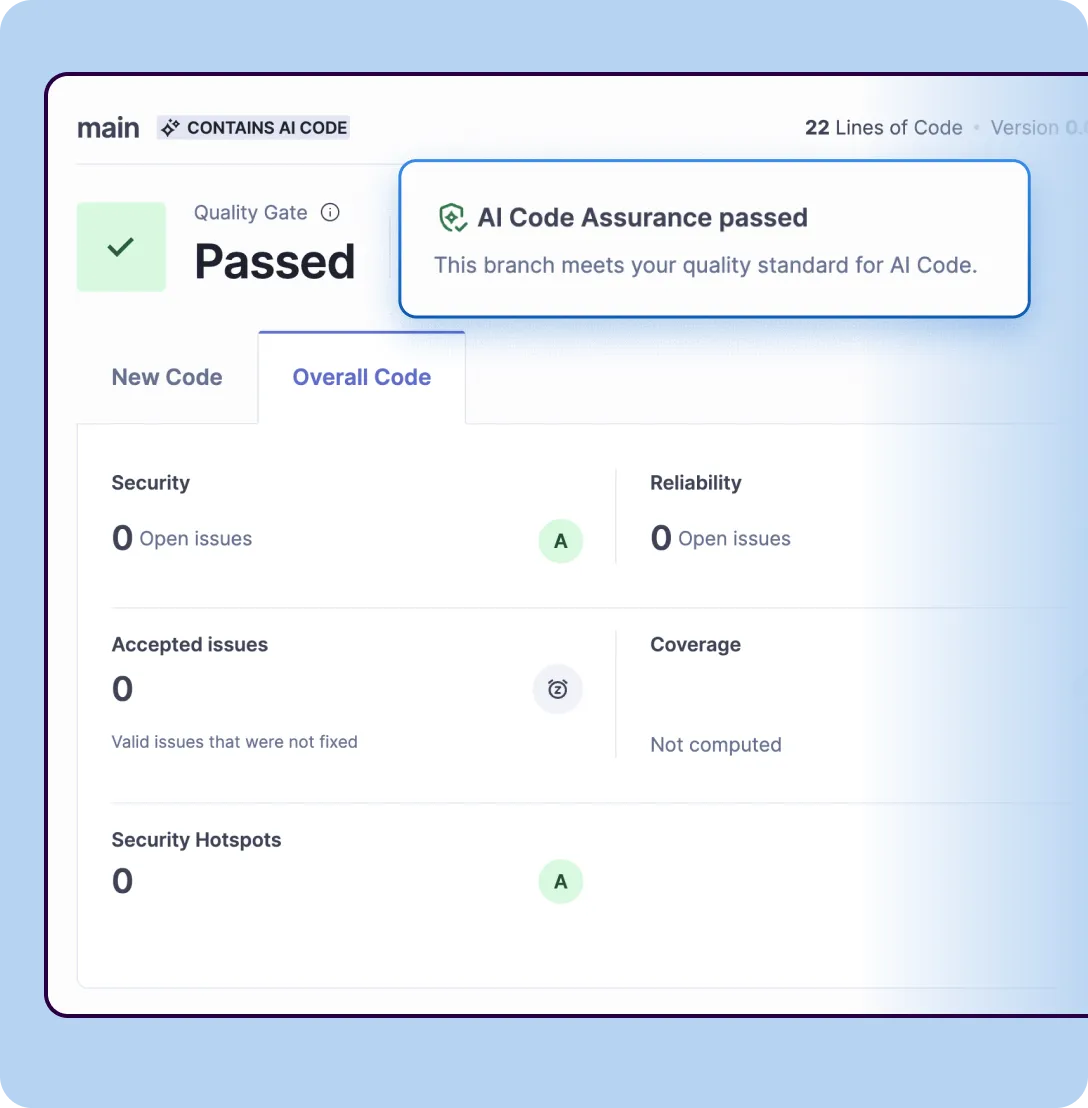
AI Code Assurance
Provides a governance framework to manage the emerging quality, security, and compliance risks of AI-generated code in your projects
Automatic code review
Analysis results displayed directly in every pull request and branch, preventing non-compliant code from being merged
Customizable quality profiles and gates
Automatically blocks pull requests and branches that don't meet your required quality, security, or test coverage standards
Software Composition Analysis (SCA)
Identifies license compliance risks from open source dependencies and generates a Software Bill of Materials (SBOM) (available with SonarQube Advanced Security)
Centralized management
Ensures all developers are working with the same set of compliance rules directly in their IDE
Ticketing integration
Push compliance issues directly to tickets for seamless tracking and remediation (coming soon)
Why choose SonarQube for regulatory compliance and reporting?
In-workflow compliance
We integrate compliance into the development lifecycle, making it a natural part of the process, not a separate phase.

Ease of reporting
Generate comprehensive evidence of compliance instantly, with a single click, simplifying your audit readiness and saving valuable time.

Actionable guidance
Get instant feedback on what steps need to be taken in order to close compliance gaps.
Resources
Full coverage of MISRA C++:2023
SonarQube provides an intelligent, high-precision, and integrated solution for development teams to achieve full, friction-free compliance with the MISRA C++:2023 coding standard for C++17 safety-critical applications.
Read more >
How SonarQube enables DORA compliance for financial institutions
With the Digital Operational Resilience Act (DORA) now fully in effect across the European Union, financial institutions must demonstrate robust cybersecurity and operational resilience capabilities.
Read more >
Cyber Resilience Act: Navigating speed and security with AI-coding
Modern software development is caught between two powerful forces. On one hand, generative artificial intelligence (AI) coding tools are supercharging development velocity at the expense of rigorous security review.
Read more >

Compliance and Reporting FAQs
What is SonarQube for compliance and reporting?
SonarQube for compliance and reporting helps organizations operationalize code compliance by setting centralized quality and security standards and enforcing them consistently across development workflows. Those standards are embedded into pull requests, CI/CD pipelines, and release processes, making them difficult to bypass and easier to apply at scale. SonarQube also provides transparent, centralized reporting that shows how policies are being enforced, where issues remain, and how remediation is progressing over time, helping teams support audit readiness, internal governance, and compliance reporting with clear evidence.
How does SonarQube help with code compliance?
SonarQube automates code review, applies centralized compliance rules, and reports issues directly in pull requests and branches. This helps teams catch non-compliant code before it is merged. It also creates a clear record of detection and remediation for audit purposes.
Which compliance standards does SonarQube support?
SonarQube supports a range of widely used security and coding standards, including OWASP Top 10, OWASP ASVS, PCI DSS, CWE Top 25, STIG, and MISRA C++:2023. It also helps organizations address code-related and secure development requirements in broader regulatory and policy frameworks such as the European Union Cyber Resilience Act (CRA), the Digital Operational Resilience Act (DORA), and NIST SSDF. With SonarQube Advanced Security, that support extends further into OSS and software supply chain risk through SCA, advanced SAST, license management, and SBOM generation.
Can SonarQube help with AI-generated code compliance?
Yes. SonarQube helps with AI-generated code compliance by applying the same centralized quality and security standards to AI-generated and human-written code, ensuring governance at the software delivery layer. SonarQube core capabilities support governance for teams using AI coding tools by embedding policy enforcement, review workflows, and reporting into everyday development. This helps organizations reduce the risk of non-compliant AI-assisted code entering production and gives compliance and security teams clearer evidence of how standards are being applied.
How does SonarQube simplify audit reporting?
SonarQube simplifies audit reporting by centralizing compliance evidence and making policy enforcement visible across everyday development workflows. It shows which quality and security standards are in place, where issues or policy breaches remain, and how remediation is progressing over time across pull requests, branches, and CI/CD pipelines. This gives teams a transparent record of enforcement and follow-up, reducing the manual effort needed to prepare for audits, support internal reviews, and produce compliance reporting.
How does SonarQube help with open source compliance risks?
SonarQube helps with open source compliance risks through Advanced Security and its SCA capabilities. It identifies vulnerabilities in third-party OSS dependencies, flags components that conflict with your organization’s license policies, and lets teams define license profiles with allowed and prohibited license rules across projects. It also supports SBOM export in SPDX and CycloneDX formats, giving organizations clearer visibility into OSS usage and stronger evidence for software supply chain governance and compliance reporting.