Software Composition Analysis (SCA) Solutions

Secure your code and software supply chain with developer‑first software composition analysis for open‑source dependencies. SCA is now included in SonarQube Advanced Security.

TRUSTED BY OVER 7M DEVELOPERS WORLDWIDE

Mercedes Benz
Nvidia
Santander

One integrated security analysis platform for all your code

code

Actionable code intelligence

SonarQube is the only integrated code quality and code security platform that delivers actionable code intelligence for first-party code, AI-generated code, and open source code—all in a single, integrated solution. No matter the source, you get a holistic view of your code’s health and security.

automatic

All-in-one code security analysis

SonarQube delivers an integrated solution for code quality, SAST, taint analysis, SCA, secrets detection, and IaC scanning. It provides comprehensive insights into bugs, vulnerabilities, CVEs, SBOMs, and licenses, streamlining your workflow and eliminating tool sprawl.

developer

Developer-centric workflow

See open source vulnerabilities and license issues directly in your PRs, CI/CD, and soon IDE. This direct feedback minimizes context switching, speeds up fixes, ensures secure dependencies, and clear risk policies keep your development pipeline unblocked.

code merge

Security compliance reports

Review the trend and severity of your security issues across single projects or entire application portfolios and generate compliance reports for industry standards such as PCI DSS, OWASP Top 10, CWE, STIG, and more. Scheduled reports allow convenient daily, weekly, or monthly delivery.

Managing security challenges in the AI & open source era

Today's rapid development, AI code, and open source reliance are amplifying complex security risks that customers urgently need to minimize. Teams need unified, developer-first controls to prioritize exploitable vulnerabilities, enforce license compliance, and secure the software supply chain.

Security vulnerabilities

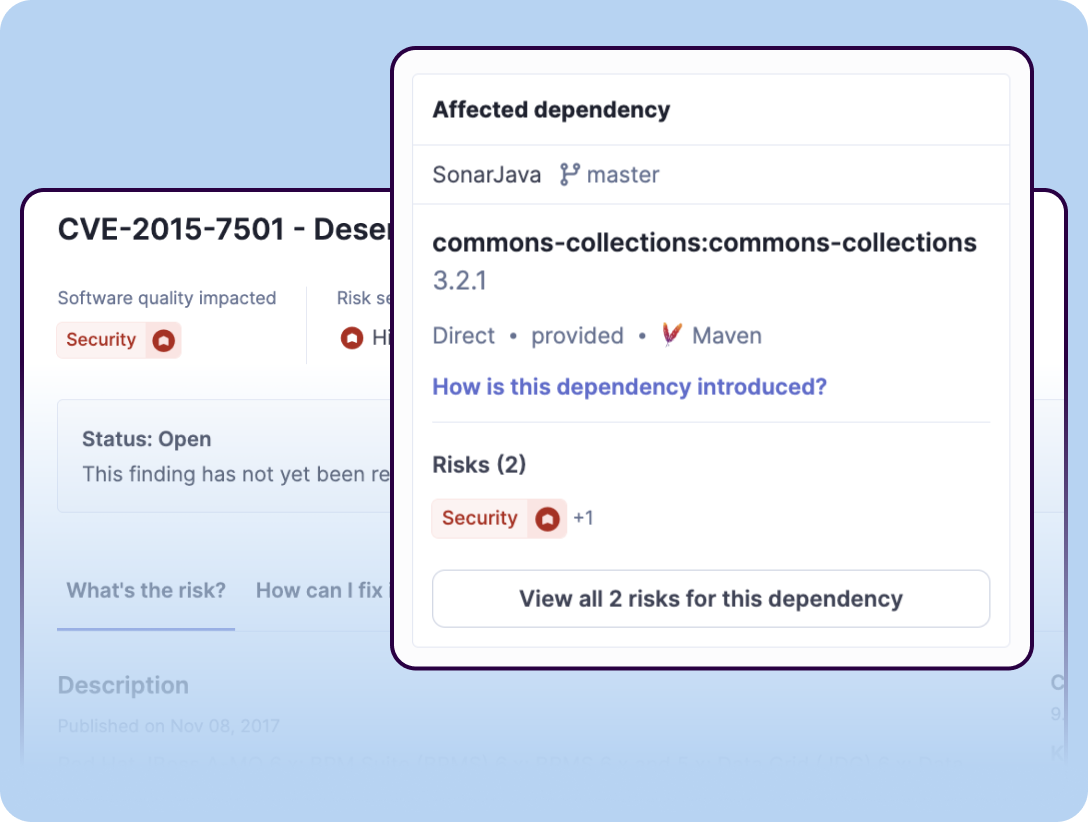
Vulnerabilities in open source dependencies expose applications to attacks. Ignoring production usage of open source packages can lead to breaches and disruptions. Attackers often weaponize disclosed vulnerabilities quickly, shrinking your remediation window. Without clear visibility and prioritization, teams drown in noisy alerts and unintentionally ship risk to production.

Image shows security vulnerabilities detected by SonarQube

How SonarQube Advanced Security solves dependency management

SonarQube is built for developers, delivering a seamless experience in the IDE, pull requests, and CI/CD. It provides actionable, prioritized insights on dependency vulnerabilities, malicious package detection, and license compliance, along with SBOM visibility.

Vulnerability detection

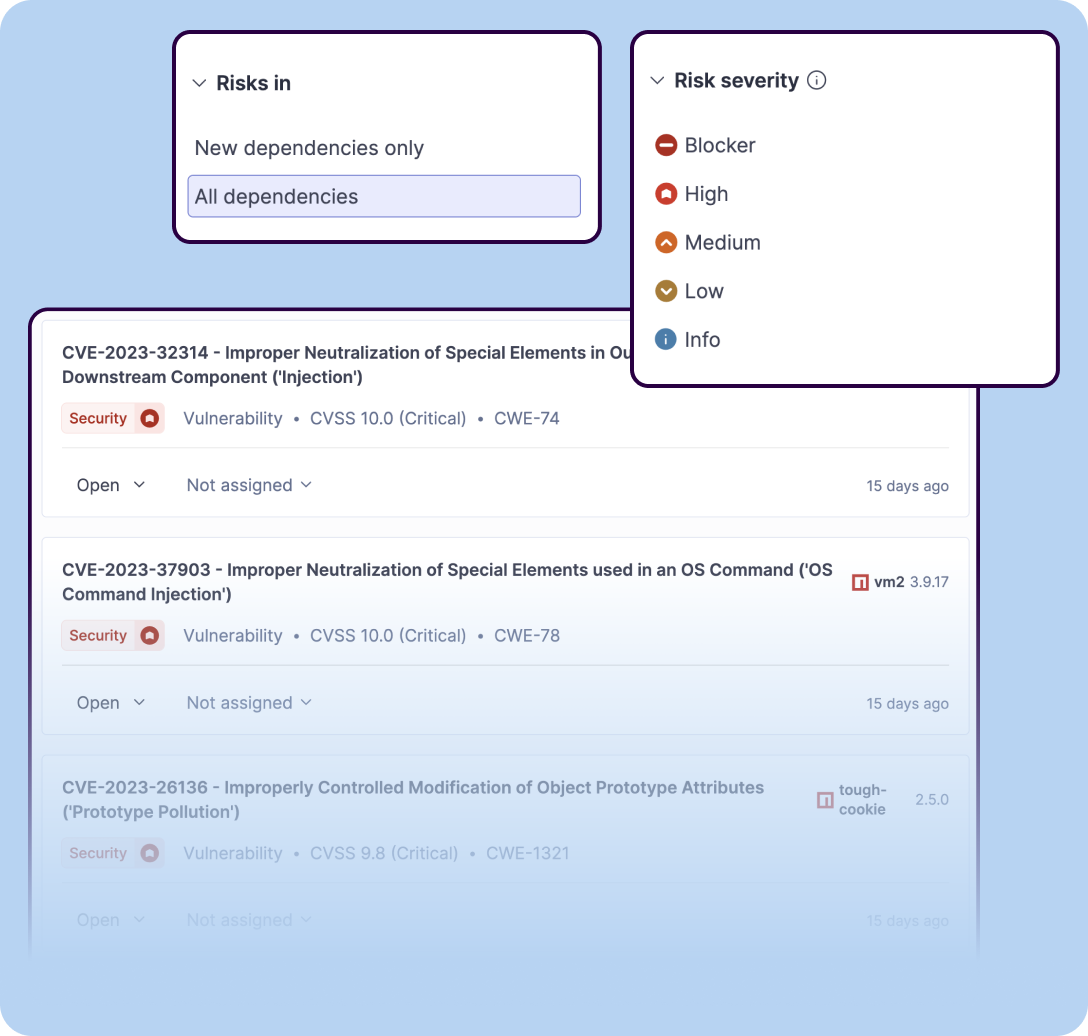
SonarQube detects known code vulnerabilities in your dependencies. Maintainer insights as well as severity and exploitability scores help you to easily prioritize and fix critical issues.

Learn more

License checks

Choose from a predefined set of prohibited or allowed software licenses or define your own policies. Automated checks flag incompatible or risky licenses before they become a problem.

Learn more

SBOM visibility

Gain complete visibility into your software supply chain. Generate and maintain a detailed SBOM for your applications, making audits and regulatory compliance straightforward.

Learn more

Malicious package detection

SonarQube detects potential malware within your dependencies. Real-time alerts and automated policy enforcement help you to easily prioritize and block high-risk software supply chain threats.

Learn more

Manage dependency risks directly in your VS Code

Ecosystem support

The benefits

Unblock developers with actionable solutions

We focus on prioritizing real issues and providing clear remediation guidance, not just a list of problems, allowing your team to resolve issues efficiently and get back to building. This reduces noise and context switching so developers can act with confidence. It also creates a repeatable path to resolution with clear ownership, timelines, and measurable impact.

Stephen Byrnes image

"We're not just keeping quality high; we're actually able to go faster … AI makes it easier to deliver velocity, but only if you provide the right context from tools like SonarQube."

Stephen ByrnesDistinguished Engineer

Scan third-party dependencies for vulnerabilities today

Frequently asked questions

What is software composition analysis (SCA) and how does it work?

SonarQube’s Software Composition Analysis (SCA) is a tool designed to help software teams manage third-party dependencies and ensure that projects are built using secure, compliant open-source components. It analyzes your codebase to identify all open-source libraries and frameworks used, assessing them for known vulnerabilities and tracking their licenses to ensure regulatory requirements are met. This process allows organizations to address potential risks originating from their software supply chain before code is shipped to production.

SCA works by scanning dependency files and associating them with central vulnerability databases. Whenever a new vulnerability or license issue is found, SonarQube Advanced Security includes SCA capabilities which provides actionable notifications, prioritization guidance, and remediation recommendations within the developer workflow. By embedding directly in pull requests and code reviews, teams can proactively improve overall software health and maintain a continuous focus on delivering quality code.

How does software composition analysis help protect against vulnerabilities in open-source dependencies?

SonarQube Advanced Security includes SCA capabilities which continuously monitors your project’s dependencies against up-to-date vulnerability databases, alerting developers when security threats are discovered in any open-source component. These insights are surfaced directly in the development workflow, enabling fast identification and remediation of vulnerabilities with minimal disruption. The tool provides detailed descriptions and risk assessments for each issue, helping teams to prioritize fixes based on severity and exploitability.

By integrating this capability throughout the pipeline, SonarQube Advanced Security includes SCA capabilities which empowers teams to maintain high standards for quality code while reducing their risk exposure. Developers receive guidance and best practices on how to update vulnerable packages and resolve supply chain threats, ensuring every release is secure and resilient against attacks targeting third-party libraries.

How does SCA ensure license compliance for open-source components?

SonarQube Advanced Security includes SCA capabilities which automatically scans your project’s dependencies to identify license types and assess license compliance against your organization’s internal policies and external regulations. It flags problematic licenses and highlights conflicts or prohibitions before delivery, streamlining the process for legal teams to verify usage and reduce risk of litigation or license violations.

By embedding license checks directly into developer workflows, SonarQube Advanced Security includes SCA capabilities which fosters accountability and simplifies compliance reviews. Developers and managers receive instant feedback during pull request evaluation, so they can make informed decisions and maintain continuous attention on compliance while building quality code. This reduces bottlenecks and supports more effective governance in modern agile environments.

What makes software composition analysis developer-centric compared to other SCA tools?

SonarQube Advanced Security includes SCA capabilities which is designed for a seamless developer experience by integrating code analysis and vulnerability management into everyday workflows, such as pull requests and code reviews. Rather than relying on manual scanning or separate security processes, SCA feedback appears where developers work, ensuring minimal context-switching and maximum responsiveness.

The developer-centric approach empowers teams to take prompt action on code health and supply chain risks, accelerating innovation and maintaining production-ready code. Recommendations for addressing vulnerabilities and license issues come embedded in actionable notifications, ensuring that building quality code is supported by automated policy enforcement and intuitive reporting.

How does software composition analysis contribute to supply chain security?

Supply chain attacks often exploit vulnerabilities or mismanagement in third-party dependencies. SonarQube Advanced Security includes SCA capabilities which enhances supply chain security by continuously tracking and evaluating every open-source component within your repositories. It maintains a real-time mapping of dependency versions and vulnerability status, allowing developers to detect and remediate risks before code is merged.

Automated checks and alerts ensure that every stage of code delivery—from initial commits to deployment—remains secure, and that no vulnerable packages slip through undetected. By combining best-practice guidance with rigorous scanning, SonarQube Advanced Security includes SCA capabilities which helps organizations build trust in their software supply chain and maintain confidence in the quality of their codebase.

Can software composition analysis be integrated into existing DevOps pipelines or CI/CD workflows?

Yes! SonarQube Advanced Security includes SCA capabilities which are designed to integrate natively into popular DevOps pipelines and CI/CD workflows. Its automated scanning capabilities can be configured to run on every build and deployment, enforcing security and compliance checks automatically as part of production workflows. This ensures that every release adheres to quality code standards without extending delivery timelines.

Compatibility with build tools and orchestration platforms—such as Jenkins, GitHub Actions, Bitbucket Pipelines, and Azure DevOps—enables teams to embed SCA checks at the earliest stages possible. Built-in notifications and reporting provide feedback directly into existing PR and commit review flows, helping teams to catch supply chain risks early and maintain momentum in agile development.

How does software composition analysis handle code quality in addition to security and compliance?

SonarQube Advanced Security includes SCA capabilities which operates as part of a unified platform that addresses dependency vulnerabilities, license compliance, and code quality all within the same workflow. In addition to scanning for third-party risks, SonarQube empowers teams to maintain a high bar for code maintainability, readability, and reliability through built-in static analysis and actionable recommendations.

The synergy between SCA and code quality assurance promotes a holistic approach to software health—developers can remediate security issues and improve coding practices simultaneously. Pull requests and commits are enriched with context about both the security and quality of changes, helping foster a culture of accountability and strengthening the integrity of every release.

What types of reports and analytics does software composition analysis provide for compliance and governance?

SonarQube Advanced Security includes SCA capabilities which offer detailed compliance reports, analytics dashboards, and audit trails that empower stakeholders to monitor risk posture across projects and teams. These reports break down vulnerabilities by severity, classify license risks, and present trends in supply chain health, making it easier for compliance teams to verify adherence to internal and regulatory requirements.

Automated export features facilitate regular compliance audits and executive reviews, ensuring transparent governance and actionable insight. SonarQube Advanced Security includes SCA capabilities which compliance reporting not only supports regulatory reviews but also helps development leaders track progress toward building consistently high-quality code, with clear visibility into the evolving health of their software supply chain.

 Does software composition analysis support multiple programming languages and package managers?

SonarQube Advanced Security includes SCA capabilities which is compatible with most popular programming languages and their respective package managers, including but not limited to Java (Maven, Gradle), JavaScript/TypeScript (npm, yarn), Python (pip, requirements.txt), and many others. This broad language support makes it suitable for organizations developing polyglot applications and helps protect codebases regardless of technology stack.

With multi-language awareness and sophisticated dependency graphing, SonarQube Advanced Security includes SCA capabilities which can surface vulnerabilities and license issues across diverse environments. Teams working on distributed applications, microservices, or large monorepos benefit from centralized tracking, consistent reporting, and unified security standards focused on building quality code.
How can teams get started with software composition analysis and maximize its impact?

To get started, teams can follow detailed onboarding guides and best-practice documentation, which walk through setup, integration, and configuration of SonarQube Advanced Security including SCA capabilities for their specific needs. Activation is straightforward; once linked with your version control system, SCA automatically begins scanning dependencies in all new and existing repositories.

To maximize the tool’s impact, teams should leverage its native pipeline integrations, customize security and license policies to align with organizational standards, and incorporate SCA findings into daily code review and release cycles. Ongoing education through SonarQube’s blog and training resources helps developers stay ahead of emerging supply chain threats and maintain the highest standards for quality code.

Unsubscribe