Secure dependencies: Ship confidently
Software supply chain security
SonarQube provides the essential code verification layer for your entire software supply chain, ensuring all code and dependencies are production-ready and secure across your development lifecycle.
TRUSTED BY OVER 7M DEVELOPERS WORLDWIDE


How SonarQube secures your software supply chain
SonarQube secures your supply chain with a unified code verification layer for logic, security dependencies, and credentials. Automated quality gates ensure all code is production-ready and secure before it reaches your Git history.

Third-party dependencies
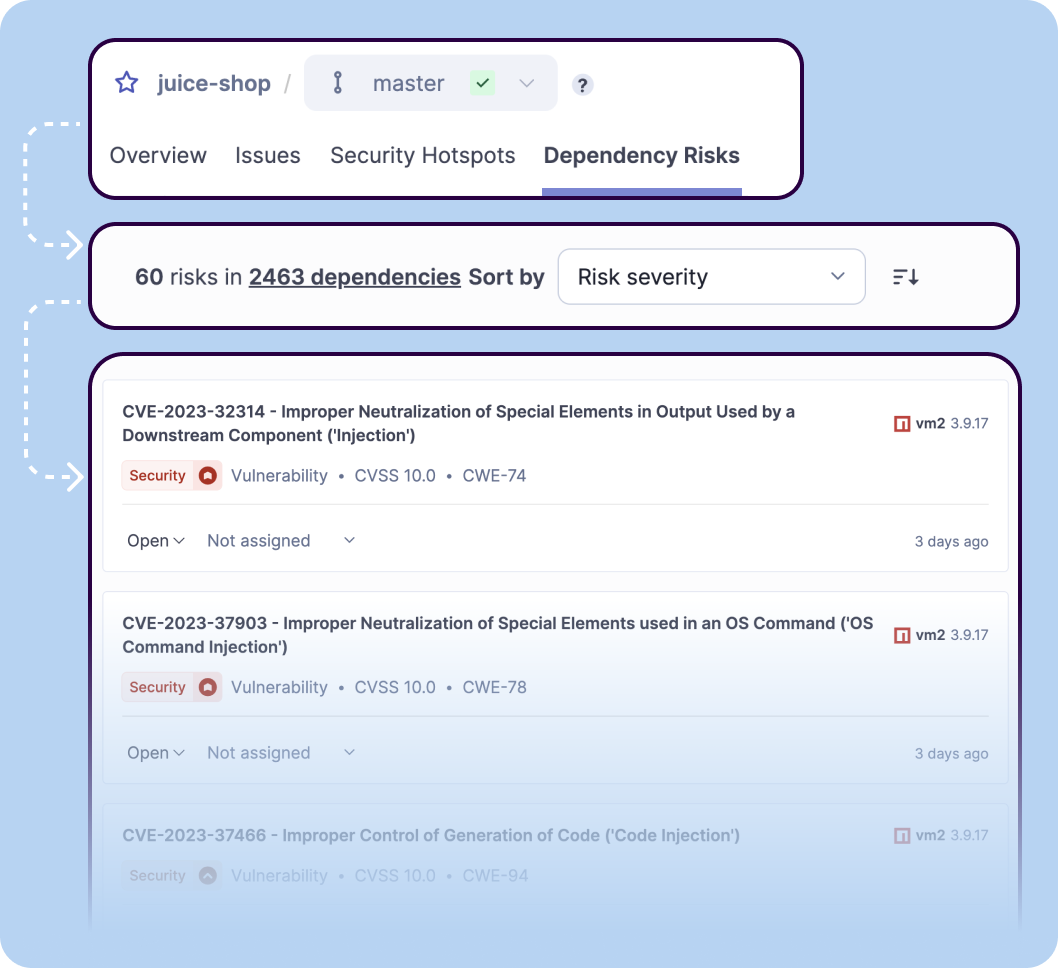
SCA identifies known security vulnerabilities (CVEs) and malicious packages in open source libraries and enforces license compliance.

Secrets and credentials
Automated detection catches hard-coded secrets, tokens, and passwords in the IDE or via the SonarQube secrets CLI before they ever reach your Git history.

Third-party libraries
Advanced SAST, analyzes how your code interacts with open source libraries to uncover complex injection vulnerabilities.

Secure pipeline workflows
SonarQube detects misconfigured GitHub Actions and Azure Pipelines. By identifying unpinned actions and script injections early, you stop attackers from exploiting workflows before a breach begins.

Java

JavaScript

TypeScript

Python

C#

C

C++

GO

Kotlin

Scala

Ruby

Rust

Kubernetes

Terraform

CloudFormation

Docker

NPM

Apache Maven

Conan

NuGet
What makes SonarQube's supply chain security unique in the industry?

Dependency-aware analysis
Unlike standalone SCA tools, Sonar traces data flows from your code into third-party libraries to uncover hidden security risks that traditional scanners miss.
Prevention-first secrets detection
Stop secrets at the source with the Sonar secret CLI and SonarQube for IDE, eliminating the need for costly credential rotation and Git history rewrites.

Unified governance
Consolidate quality and security into a single workflow with centralized quality gates, providing a single source of truth for platform engineering and security teams.
Why your supply chain attack surface is expanding
Supply chain attacks exploit open source dependencies, CI/CD pipelines, and AI tools to inject malicious code and steal credentials.
Read more >
Stop malicious packages in your CI/CD pipeline
The key remediation suggested during the early days of malware was “don’t install or execute code that isn’t from someone you trust.” Well, about that…
Read more >
Software Supply Chain Security
Software supply chain security comprises proactive and reactive practices to manage risks from creation to distribution, emphasizing vital tools, processes, and open source components.
Learn more >
SonarQube Advanced Security vs. other SCA solutions
SonarQube SCA is built for this reality, helping teams govern open-source risk and pipeline integrity without slowing down delivery.
Learn more >
Securing the software supply chain
With SonarQube, you've already made an investment in code quality and code security. Your teams benefit from core capabilities essential for securing the code they write.
Download >
Developer-first SCA across your workflow with SonarQube
SonarQube Advanced Security includes software composition analysis (SCA), which helps you secure and govern open source dependencies without slowing developers down.
Download >

Frequently asked questions
What is software supply chain security and why does it matter?
Supply chain security involves securing everything that goes into your software, including first-party code, third-party libraries, and configuration files. It is critical because attackers increasingly target the "weak links" in open-source dependencies or exposed secrets to gain unauthorized access to enterprise systems.
How does SonarQube differ from traditional SCA tools?
Most SCA tools only provide a list of vulnerabilities found in your dependencies. SonarQube goes further by integrating SCA with Advanced SAST. This allows you to see if your code actually interacts with a vulnerable library, reducing noise and helping developers prioritize the fixes that actually reduce risk.
What are the most common types of software supply chain attacks?
Common software supply chain attacks include compromising popular open source packages, inserting malicious code into build scripts or CI/CD pipelines, tampering with artifacts in registries, and abusing unverified third‑party services.
In dependency‑focused attacks, adversaries may publish malicious updates to widely used libraries or exploit known vulnerabilities like Log4Shell, instantly impacting thousands of applications that transitively rely on the affected component.
Other attack patterns focus on the development and delivery process itself—abusing compromised developer credentials, manipulating build environments, or poisoning artifacts so that every downstream consumer inherits the compromise.
Because these attacks exploit existing trust relationships, they can remain undetected for long periods and are often discovered only after widespread damage has occurred, making prevention and early detection critical.
What are best practices to improve software supply chain security?
Strong software supply chain security starts with comprehensive inventory and governance: maintain an up‑to‑date view of all software components, enforce clear policies for third‑party usage, and conduct regular vulnerability scanning across your environment.
Complement this with proactive vendor and OSS evaluation, continuous monitoring and threat intelligence, and a well‑defined incident response plan so you can react quickly when high‑profile vulnerabilities or breaches emerge.
At the development level, integrate security into the SDLC with code review, automated testing, and developer training that emphasizes code quality and secure use of dependencies.
Adopting frameworks like SLSA or related industry standards helps structure your efforts, while focusing on new code quality—sometimes described as quality at the source or a focus on new code—lets you enforce strong gates on every change without being blocked by legacy issues.